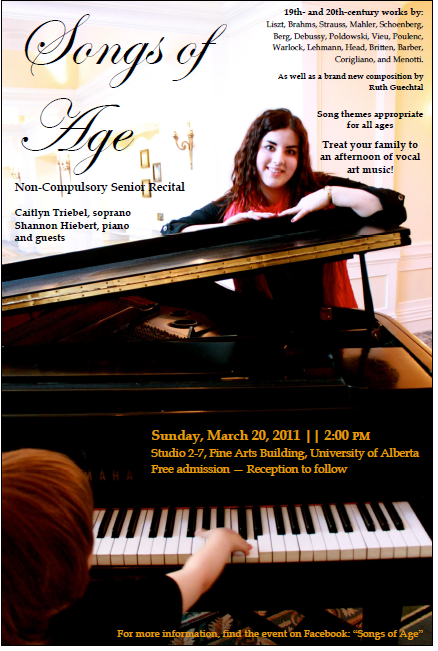
My name is Caitlyn Triebel and I am a white settler, second generation German on my father’s side and French Canadian on my mother’s side. I was born and raised in Dawson Creek, BC where most of my immediate family still lives. I was the only girl with three brothers, and we had an active upbringing with lots of skiing, swimming, playing baseball, camping, bike riding, and running around with neighbourhood friends. As I went through high school singing became more and more important, and I also worked hard on piano to get my grade 8 credentials. Some of my most foundational musical experiences as a teenager were with the Dawson Creek Symphonette & Choir, directed by Mrs. Rotraud Lopp. Through these annual productions, I saw how months of worth of hard work put in by ordinary people could culminate in an amazing display of closeness through performance.
A poor quality video from my 2009 Sophomore Recital, KPAC, Dawson Creek
I went to school in Grande Prairie and then Edmonton, and lived there just me and my first son Kaspar. At UofA I did my Bachelor of Music and then my Master of Arts. My main focus as an undergrad was voice and music history, and then I zeroed in on 20th century music history and philosophy for my masters. In 2013, I attended a summer intensive in Austria at the Franz-Schubert-Institut. It was an incredible learning experience that taught me so much about the value of poetry in song. Later that summer, my son and I travelled to Cardiff, UK where I would have begun my doctoral studies. Things did not go according to plan and we moved back to Dawson Creek to be closer to family and so I could regroup a little after many years on the post-secondary grind. The door hasn’t closed on my university journey forever, but that chapter came to an end in the blink of an eye.
As a 25-year-old in the middle of the university climb, it sure felt devastating to land back in my home town. My parents, brothers, and the few friends I had still in town were vital for me to regain my footing and begin to see possibility in this change. Still, we desperately missed our old life and the excitement of the city. How privileged I was to be able to get the education and meet the people I did, and have my preschooler along with me through it all.
As a young mom and music student, I was always really interested in children’s music and the value of exposing children to many different musical styles and environments. We went to concerts, street festivals, and heavy metal shows while I studied classical art music and opera and listened to endless amounts of folk music. As a student of musicology, I pursued many different research areas which at the time seemed very disjointed and unrelated. Looking back, I see a common thread throughout: I was always interested in music that pushed boundaries, reached beyond the limits of the expected, protested against old, outdated, or discriminatory views. My research topics included:
So many different musical interests and the people around those interests have played into how I teach and how I interact with students and program participants.
When I was young, Dawson Creek had a thriving music community, with several full-time piano teachers, voice lessons, Symphonette & Choir, community musical theatre productions for children and adults, the Kiwanis Band, and regular recitals and bursary competitions put on by the Music Teachers Association and Kiwanis Performing Arts Centre. With the exception of the Kiwanis Band, almost all of that was gone by the time I moved back in 2013. I started teaching voice lessons that first year back. I was joined by my best friends and fellow music teachers from Edmonton for “Dawson Creek Music Explorers,” a week-long kids music camp for piano, voice, and violin hosted graciously at St. Marks. We did it again two years later at the KPAC, with another Edmonton-based teacher joining us for guitar.
In 2014 with a lot of encouragement, I pursued the idea to start the first choirs that became the Dawson Creek Choral Society. I had never led a choir before, other than practicing in a conducting course during my bachelors. I’d taught voice, and brought in my knowledge of vocal anatomy, expression in singing, and attention to text. Before this, I was never really interested in choir, per se, but more interested in the way that song and singing together brings people into a deep connection that truly means something. I learned a lot of things that first year, and have continued to learn as a choir director every year since.
Dawson Creek Choral Society Winter Gala 2016
Cantabile Mixed Choir (then called the Community Singers) performing Eric Whitacre’s “The Seal Lullaby”
Caitlyn Triebel, conductor
Aaron Marchuk, piano
It was soon evident that the Dawson Creek Choral Society was something that people wanted in our community. We formed a Board of Directors and then incorporated as a Society in March 2015. These first years would not have happened without the creative collaborative work I did with Randi Jo Torgrimson, Caylee Tietjen, Aaron Marchuk, and Carmen Willms. Around the same time I was volunteering with the South Peace Historical Society and beginning my journey into grant writing and community advocacy for non-profits. I spent a bit of time working for Tourism Dawson Creek also. All these non-musical experiences gave me an acute sense of need and different interests in the community, and the economic development strategies surrounding these needs.
In 2015, the DCCS added a JR Musical Theatre program with Randi Jo Torgrimson, Aaron Tremblay, and myself teaching and producing our first collaborative junior musical. I had grown up doing high school musicals and was a vocal coach for many musical theatre students during my university years and early time back in Dawson. But I’d never done children’s musical theatre and quickly realized that getting kids to not only project their voices but also their emotions and acting while singing was a new challenge altogether.
DCCS Winter Gala 2016
with Alice Curitz, flute
In 2020, all H-E-double-hockey-sticks broke loose and teaching music as I knew it was no longer a valid career choice. I took a new job at the Nawican Friendship Centre and fell in love with social service work and Indigenous culture and knowledge. My family also expanded significantly when I met my life partner and we became a blended family of 6. Our family was rounded out in 2022 with the birth of our youngest spitfire, Magnus. With a big family just learning to navigate through the days, and ongoing outbreaks of the coronavirus, I had to put music on hold. Yet I grieved (and still do grieve) all that was lost in 2020 and I still can’t begin to truly describe the artistic and creative heartbreak that’s followed me for the last four years. The DCCS was such an important part of me (likewise, I think, for the many people anxiously waiting the day we’d join again) that it couldn’t stay away forever.

So, sometime in early spring of 2024, we started talking among our previous DCCS directors about how we go about getting started again. There were many steps to dusting off the Society and bringing us back into alignment not just with the BC Registry, but also with the ways that our own lives had grown and changed, with new social and economic contexts from which we’d need to emerge. Through this process I felt gratitude for the work I had done in 2019 to establish a solid brand for the Choral Society, a brand that was easily updated and still fell mostly within my design style. It’s been updated though, with even more emphasis on community, connection, and doing our part in guiding people to find their voice.
I couldn’t be more thankful for my family and our past and present Board of Directors for believing that the DCCS could rise again. A tangent: In university, I wrote a term paper and presented at a couple of conferences around Canada on a French Canadian ballet score by Clermont Pépin, L’oiseau-phénix (1956). Through my research, I would highlight the many different ways in which mid-Century art music (particularly that originating from French Canada) had a period of decline, refusal, and rebirth. I also realized that the song Pépin chose for his oiseau-phénix was very much like the song of the red-wing blackbird, one of the common bird calls heard throughout rural Quebec. I guess what I’m realizing is that all of us go through these phases at different times in life. When COVID-19 turned our entire world upside down, it’s like we all experienced this phase of internal global refusal, right alongside and with our society. I believe it’s time to rise again, and regain our sense of belonging, connection with others, and community. From the most common voices, like the blackbird, we can create something extraordinary. Having role models and things that inspire us to get along and cooperate for the common good. Welcoming those experiences in which we come side by side with people we may not normally cross in our day to day lives. No longer being afraid to simply be together.
As we rise from the ashes left so purposefully (and sometimes mercilessly) by the phoenix, we can breathe the same air once more and find those powerful voices that have been inside us all this time. We rise for those who came before us, those who shaped us every step of the way, and for those who are yet to be inspired. Let’s sing.

Subscribe to get the latest posts sent to your email.
Subscribe now to keep reading and get access to the full archive.